
Custom Healthcare Software Development Company in India: A Practical Guide
Looking for a custom healthcare software development company in India? Explore solutions, key features, security, costs, and vendor selection factors.
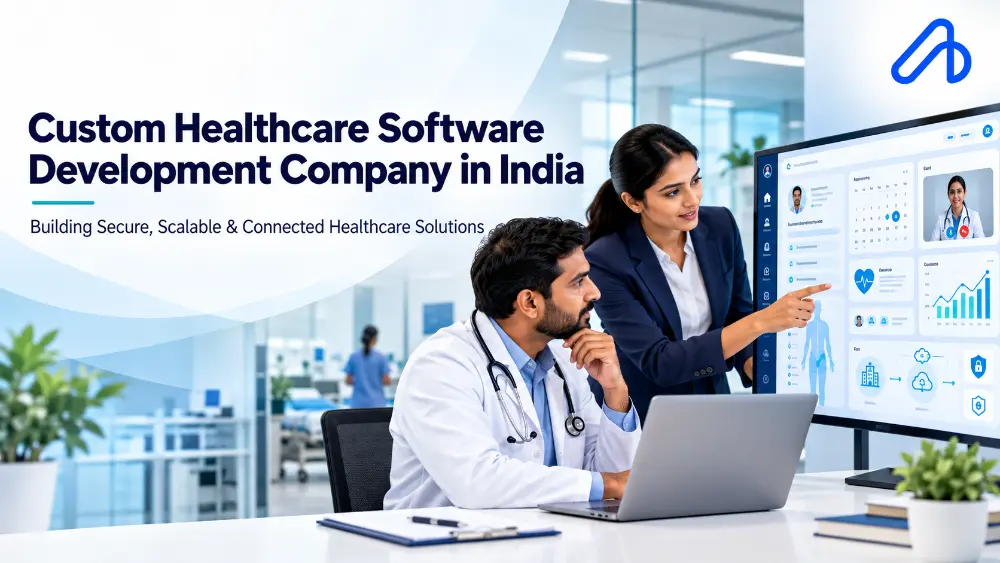
Healthcare organizations are under growing pressure to deliver faster, more connected, and more convenient patient experiences. Yet many hospitals, clinics, diagnostic centers, and health-tech businesses still depend on disconnected systems or software that does not match their workflows.
This is where working with a custom healthcare software development company in India can make a difference.
Instead of forcing teams to adapt to a standard product, custom development allows an organization to build software around its users, workflows, integrations, security needs, and long-term business goals.
However, healthcare software is not just another mobile app or business dashboard. Patient information can be sensitive. Systems may need to exchange data with other healthcare platforms. Reliability, access control, privacy, interoperability, and regulatory requirements can influence almost every development decision.
This guide explains what custom healthcare software development involves, the solutions businesses can build, important security considerations, development stages, cost factors, and what to examine before selecting a development partner in India.
What Is Custom Healthcare Software Development?
Custom healthcare software development is the process of designing and building a digital solution for the specific requirements of a healthcare organization or health-tech business.
Unlike an off-the-shelf product, custom software can be designed around existing clinical and administrative workflows.
For example, a multi-location diagnostic business may need a platform that connects patient registration, appointments, laboratory workflows, reports, billing, and notifications.
A telehealth startup may have very different requirements. It could need video consultations, doctor scheduling, electronic prescriptions, patient records, payment processing, and secure communication within one platform.
The purpose of customization is not simply to add more features. A good development strategy focuses on building the right features for the people who will actually use the system.
These users can include:
Doctors and nurses
Patients and caregivers
Hospital administrators
Laboratory teams
Pharmacists
Insurance or billing teams
Healthcare business owners
Understanding these users early can prevent expensive changes later in the project.
Why Healthcare Businesses Choose Custom Software
Ready-made healthcare products can work well when their features closely match an organization's needs. Custom development becomes more relevant when existing products create workflow limitations or cannot support important integrations.
Software Built Around Existing Workflows
Healthcare teams often follow processes that have developed over many years. Replacing them with a rigid system can create additional work instead of reducing it.
A custom platform can map software workflows to the organization's actual processes.
For example, an appointment platform could support different consultation durations for different departments, while a hospital management system could implement role-specific workflows for receptionists, doctors, nurses, and administrators.
Better Integration Possibilities
A healthcare organization rarely operates with only one application.
A new platform may need to communicate with:
Electronic health record systems
Laboratory information systems
Pharmacy platforms
Billing systems
Payment gateways
Medical devices
Appointment systems
Insurance-related systems
SMS, email, or notification services
Integration requirements should therefore be discussed during planning rather than treated as an afterthought.
Greater Control Over Product Development
Custom development gives a business more control over its roadmap.
Features can be prioritized according to operational needs. The product can also evolve as the organization grows, although scalability still depends on good architecture and engineering decisions.
This flexibility is particularly useful for health-tech companies building a product rather than simply purchasing internal software.
Custom Healthcare Software Development Services in India
The term “healthcare software” covers a wide range of products. A healthcare software development company in India may work on one or several of the following solutions.
1. Hospital Management Software
Hospital management systems can bring clinical, operational, and administrative activities into a more connected environment.
Depending on the project, modules may cover registration, appointments, inpatient and outpatient management, billing, inventory, pharmacy operations, laboratory processes, and reporting.
The required modules should be based on the hospital's real workflows rather than on a long feature checklist.
2. EHR and EMR Solutions
Electronic health record (EHR) and electronic medical record (EMR) systems help healthcare professionals digitally manage patient information.
Such platforms may include medical history, clinical notes, diagnoses, medications, reports, and treatment-related information.
Building these systems requires particular attention to authorization, auditability, data exchange, usability, and privacy.
3. Telemedicine Software
Telemedicine platforms can connect patients and healthcare professionals remotely.
Common functionality may include:
Doctor discovery and scheduling
Video consultation
Patient onboarding
Digital payments
Secure messaging
Prescription workflows
Notifications
Follow-up management
The exact capabilities should depend on the intended market and applicable healthcare requirements.
4. Patient Portals and Mobile Apps
A patient-facing portal can give users easier access to selected healthcare services.
Patients might use an application to book appointments, view reports, receive reminders, access permitted health information, or communicate with a healthcare provider.
Patient apps should be designed for simplicity. Adding more options does not automatically create a better patient experience.
5. Laboratory and Diagnostic Software
Diagnostic centers can use custom software to manage test bookings, sample workflows, status updates, reports, and integrations.
For multi-location businesses, the system may also need centralized administration and location-specific permissions.
6. Remote Patient Monitoring Solutions
Remote patient monitoring systems can collect or receive health-related information outside a traditional clinical environment.
Depending on the intended use, these solutions may integrate with connected devices or other data sources.
Because clinical decisions could potentially depend on the information presented, data quality, reliability, device integration, and the intended use of the software require careful evaluation.
Features That Matter in Healthcare Software
A professional development team should not start by asking, “How many features can we build?”
A better question is, “Which workflows and user problems must this software solve?”
Some commonly considered capabilities include appointment management, patient profiles, role-based access, reporting, notifications, dashboards, search, billing integrations, and document management.
However, three areas deserve particular attention.
Role-Based Access
Not every employee should automatically have access to every piece of information.
Permissions can be designed around roles and responsibilities. A receptionist, clinician, laboratory employee, and system administrator may require very different levels of access.
The authorization model should be defined during product planning and reviewed as workflows evolve.
Audit Trails
For systems handling sensitive information, it can be useful to maintain records of important actions within the application.
The precise logging and retention requirements depend on the system, organization, applicable rules, and risk profile.
Interoperability
Healthcare data can lose much of its practical value when trapped in isolated systems.
Where appropriate, development teams should consider relevant interoperability approaches and standards such as HL7 FHIR (Fast Healthcare Interoperability Resources).
FHIR should not simply be added to a marketing checklist. Teams need to determine what information must be exchanged, with which systems, in what format, and under what authorization model.
Healthcare Software Development in India: Privacy and Security Considerations
Security cannot be reduced to one feature added before launch.
It needs to influence architecture, software development, infrastructure, testing, access management, monitoring, and ongoing maintenance.
India also has an evolving digital-health and data-protection environment. Organizations should determine which requirements apply to their specific product, data, users, and markets with appropriate technical and legal expertise.
Data Protection
India's Digital Personal Data Protection Act, 2023 (DPDP Act) established a framework for processing digital personal data.
Healthcare businesses developing or deploying systems in India should assess their obligations based on the actual processing activities and applicable rules rather than relying on a generic “DPDP compliant” badge.
Product planning may need to consider areas such as data collection, user notices, consent where applicable, access controls, retention practices, and processes for handling relevant data requests.
ABDM and Digital Health
The Ayushman Bharat Digital Mission (ABDM) is an important part of India's digital-health ecosystem.
Organizations that plan to participate in or integrate with relevant ABDM ecosystem components should study the current technical specifications and policies published by the National Health Authority rather than assuming every healthcare application requires the same integration.
Security by Design
Depending on the application's risk profile, development teams may consider measures such as:
Encryption for appropriate data in transit and at rest
Strong authentication
Least-privilege access
Secure API design
Audit logging
Vulnerability management
Secure backups
Monitoring and incident-response processes
Dependency and patch management
Security testing
OWASP guidance can also help engineering teams identify common web and application security risks.
Security, however, is an ongoing process. No responsible software provider should treat an application as permanently or “100%” secure.
What About HIPAA?
HIPAA is a United States healthcare framework. Being a healthcare application built in India does not automatically mean HIPAA applies to it.
If software is being developed for organizations or workflows subject to U.S. requirements, the development and deployment approach may need to account for applicable HIPAA obligations.
The same principle applies when a product serves users in multiple countries: requirements should be mapped to the jurisdictions, organizations, data, and intended use involved.
Development Process for Custom Healthcare Software
A structured development process can reduce ambiguity before major engineering resources are committed.
Step 1: Discovery and Requirement Analysis
The project starts by understanding the problem.
Stakeholder interviews, workflow analysis, user roles, technical constraints, integration requirements, security considerations, and business objectives can all form part of discovery.
The output should be more meaningful than a simple feature list.
Step 2: Product Scope and Architecture
Once requirements are clearer, teams can define the initial scope and make architectural decisions.
This stage may include technology choices, database planning, API strategy, infrastructure considerations, integration planning, and non-functional requirements such as performance and availability.
Step 3: UX and UI Design
Healthcare software can involve complex workflows, but the interface should not make those workflows harder.
Designers should consider the needs of each user group.
A doctor's dashboard, for example, should prioritize different information from an administrative dashboard.
Step 4: Development
Developers then build the approved functionality in planned iterations.
The exact technology stack should be chosen according to the product's requirements rather than because a particular framework is fashionable.
Step 5: Testing
Testing can cover functionality, integrations, usability, compatibility, performance, and security.
Healthcare products may also require additional validation depending on their intended use and regulatory context.
Step 6: Deployment and Ongoing Improvement
Launching the application is not the end of the software lifecycle.
Healthcare software may require monitoring, security updates, bug fixes, infrastructure maintenance, feature improvements, integration updates, and user-support processes.
The maintenance model should therefore be discussed before the initial launch.
How Much Does Custom Healthcare Software Development Cost in India?
There is no reliable single price for “healthcare software development.”
A basic appointment solution and a multi-module hospital platform are completely different projects.
Development cost can be influenced by:
Number and complexity of features
Web, mobile, or multi-platform requirements
Number of user roles
Third-party integrations
Existing system integrations
UI/UX requirements
Security requirements
Data migration
Infrastructure architecture
Testing requirements
Maintenance and support
Regulatory or market-specific requirements
For this reason, extremely precise prices offered before requirements are understood should be treated carefully.
A more useful approach is to complete discovery, prioritize the initial release, and obtain an estimate based on a documented scope.
An MVP (Minimum Viable Product) may also be appropriate for some health-tech businesses. But “minimum” should refer to product scope—not to minimum security, reliability, or essential quality controls.
How to Choose a Custom Healthcare Software Development Company in India
Choosing a development partner based only on the lowest quotation can create hidden costs later.
Businesses can evaluate potential partners using several practical questions.
Do They Understand the Healthcare Domain?
A team does not need to claim expertise in every area of healthcare. It should, however, be able to discuss the workflows and risks relevant to the proposed product.
Ask how the company approaches patient data, user roles, integrations, interoperability, and security.
Can They Explain Their Technical Decisions?
A good technical partner should be able to explain why a particular architecture or technology fits the project.
Complex terminology is not a substitute for clear reasoning.
How Do They Approach Security?
Ask about secure development practices, authentication, authorization, code review, testing, dependency management, vulnerability handling, infrastructure, backups, and incident processes.
The answers should go beyond “we use encryption.”
What Happens After Launch?
Understand the support arrangement before signing a contract.
Important questions include who handles production issues, how security patches are managed, what support hours are available, how future development is estimated, and what documentation is delivered.
Who Owns the Product and Code?
Contracts should clearly address intellectual property, source-code access, documentation, infrastructure access, third-party components, confidentiality, and handover arrangements.
Legal professionals can review contractual terms where appropriate.
Why Consider India for Healthcare Software Development?
India has a large technology-services ecosystem, making it one of the locations organizations may evaluate when sourcing custom software development.
But geography alone does not determine project quality.
A successful healthcare project depends on the specific team's engineering capability, healthcare understanding, communication, product management, security practices, testing discipline, and ability to provide long-term support.
Instead of asking only, “Is this company in India?” decision-makers should ask:
“Can this team understand our healthcare workflow and build, maintain, and support the system responsibly?”
That question is far more useful during vendor evaluation.
Conclusion
Choosing a custom healthcare software development company in India requires more than comparing feature lists and development prices.
Healthcare software can touch sensitive data, critical workflows, multiple user groups, and existing clinical or business systems. The right development process therefore begins with understanding the problem before choosing technologies or building features.
Organizations should examine a potential partner's healthcare understanding, engineering approach, security practices, integration capabilities, communication, testing process, and post-launch support.
Most importantly, custom software should solve a measurable healthcare or operational problem. Technology is valuable when it makes workflows clearer, information more accessible to authorized users, and digital healthcare experiences more useful.
Before starting development, document the existing workflow, identify the most important user problems, map required integrations, and define what a successful first release should achieve. That creates a much stronger foundation for discussing scope, architecture, timelines, and development costs with potential technology partners.
Frequently Asked Questions
What is Custom Healthcare Software Development Company in India: A Practical Guide and why is it important in 2026?▼
Healthcare organizations are under growing pressure to deliver faster, more connected, and more convenient patient experiences. Yet many hospitals, clinics, diagnostic centers, and health-tech businesses still depend on disconnected systems or software that do...
How much does Custom Healthcare Software Development Company in India cost?▼
Costs typically range based on project scope, custom database complexity, third-party API integrations, and ongoing support retainers. Contact our team for an exact quotation tailored to your specifications.
How long does implementation take and what is the process?▼
Development timelines range from 2 to 6 weeks depending on custom feature requirements. The workflow follows discovery, UI/UX architecture, sprint development, QA testing, and live deployment.
Why choose Anavya Infotech for Custom Software?▼
Anavya Infotech combines lead software architects, modern Next.js/React engineering, transparent milestones, and cost-effective delivery to build production-grade platforms.